
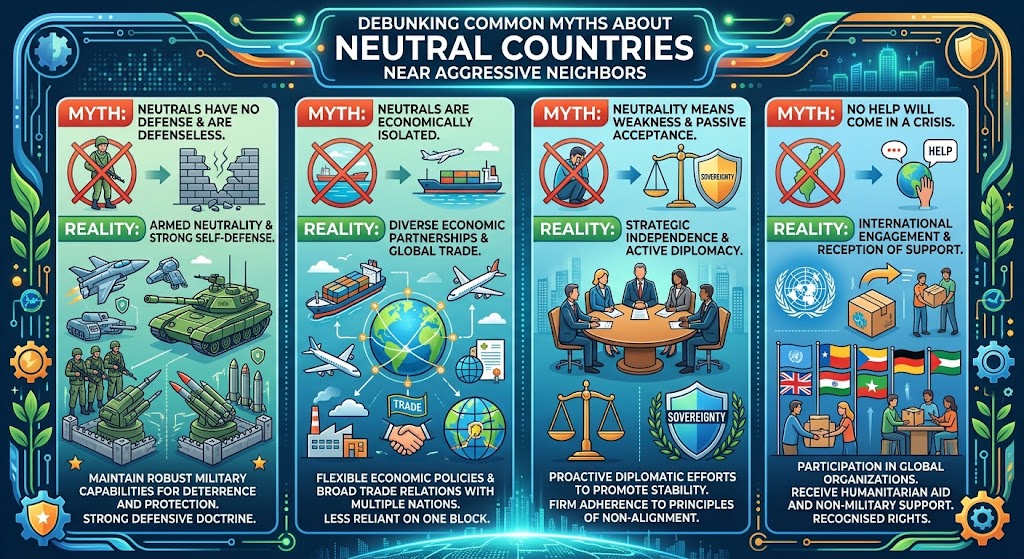
Debunking the Myth: The Illusion of Safety in Neutrality
The concept of a “neutral country” often conjures images of peace, safety, and a clever avoidance of international conflict. The perception is that by refusing to take sides, a nation can avoid becoming a target and maintain stability. However, this is a dangerous misconception, particularly for a small country sharing a border with a larger, aggressively expansionist neighbor. Far from a guaranteed shield, neutrality in such a scenario often becomes a major strategic vulnerability, exposing the nation to greater risks than alignment.
The core fallacy lies in the assumption that neutrality is respected by aggressive actors. History and political science demonstrate that an expansionist regime’s actions are driven by internal motivations, ideology, and opportunities for conquest, not by a target’s diplomatic status. In fact, a neutral neighbor can be viewed as an easier target because its isolation makes it simpler to overrun. Without the protection of strong mutual defense treaties and powerful allies, the neutral nation stands alone. It becomes a strategic void, an enticing objective for a neighbor that seeks to secure its borders, control critical resources, or simply fulfill ideological imperatives for dominance.
Furthermore, neutrality often comes with significant diplomatic and economic costs that weaken a nation from the inside. Without strong alliances, a country faces reduced geopolitical leverage and is easily excluded from key international decision-making processes, particularly on regional security. This leaves its concerns unaddressed and voices unamplified. It also means less favorable trade agreements and an increased risk of economic and humanitarian spillover effects from the neighboring conflict, such as refugee crises or trade blockades.
Fundamentally, passive neutrality is not a strategy; it is a lack of one. When a nation’s security is at stake, failure to prepare for the inevitable often leads to the worst possible outcome. Preparing for defense within a collective security arrangement is a proactively defensive measure. True safety lies not in a false sense of security derived from an unofficial pact of non-aggression but in the robust deterrence that only credible alliances and preparation can provide. Ignoring this reality is not just naive; it is a gamble with a nation’s sovereignty.