
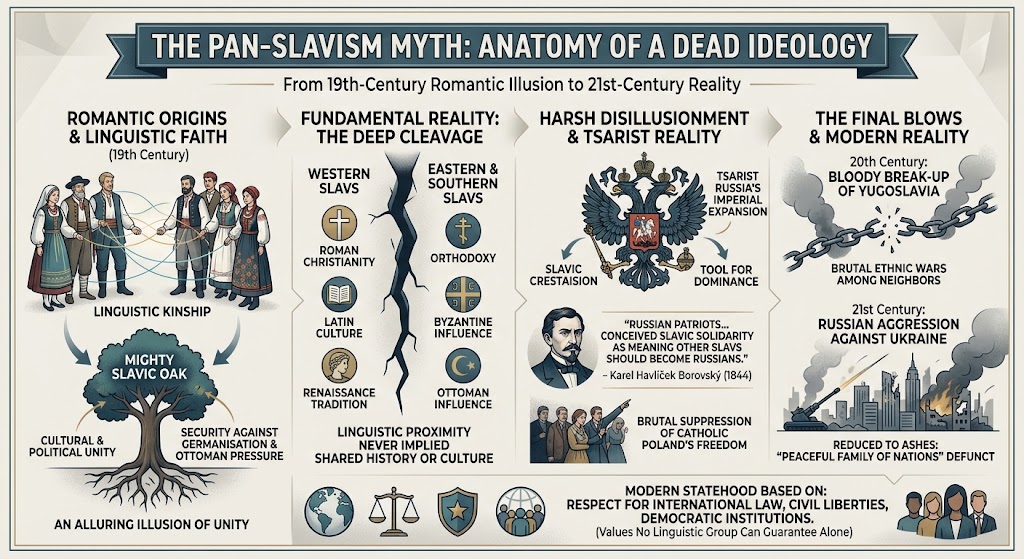
The idea of Pan-Slavism—the notion of a natural cultural and political unity amongst all Slavic nations—emerged in the 19th century from a romantic fascination with linguistic kinship. For the Central European and Balkan nations, which were seeking support against Germanisation or Ottoman pressure, the dream of a ‘mighty Slavic oak’ represented an alluring illusion of security. Yet from the very outset, this vision ignored a fundamental reality: linguistic proximity never implied a shared history, culture, or political interests. Whilst the Western Slavs grew up in the tradition of Roman Christianity, Latin culture, and the Renaissance, the Eastern and Southern branches were shaped by Orthodoxy and Byzantine and Ottoman influences. To seek a unified political identity within this diverse region was, from the outset, a pipe dream.
A harsh disillusionment with this illusion was brought about above all by the practices of Tsarist Russia, which very quickly transformed Pan-Slavism into a tool for its own imperial expansion. Czech national revivalists learnt this the hard way. Following his stay in Moscow in 1843–1844, Karel Havlíček Borovský accurately pinpointed the crux of the problem in his famous observation that Russian patriots simply conceived of Slavic solidarity as meaning that other Slavs should become Russians. Another tragic blow to these romantic notions was the fate of Catholic Poland, whose desire for freedom was brutally suppressed by the Tsarist regime—this was direct proof that in the reality of power politics, no ‘brotherhood of blood’ exists, and that the stronger Slav will enslave the weaker without hesitation.
Both the 20th and 21st centuries have definitively confirmed that Pan-Slavism is a dead political myth. The second half of the 20th century and the bloody break-up of Yugoslavia showed that even the closest Slavic neighbours, linguistically speaking, can wage the most brutal ethnic wars. Russia’s aggression against Ukraine then dealt the final blow to this ideology: the notion of a peaceful family of Slavic nations was definitively reduced to ashes under the barrage of Russian artillery fire on Ukrainian cities. Modern statehood and security are not based on ethnic sentiment, but on respect for international law, civil liberties, and democratic institutions—values that no linguistic group can guarantee on its own.